
Most of our lives are harder than they need to be because many of us never truly learn to put ourselves forward, stand our ground and understand what assertiveness really is. The true meaning of assertiveness is the ability to put forward our needs, boundaries and perspectives in the face of disagreement, in a way that remains credible, dignified, calm and effective.
Every day we are confronted with moments that require us to speak up:
- A neighbour who oversteps your privacy.
- A sibling giving consistent, unsolicited advice.
- A boss who repeatedly crosses your time boundaries, leaving you wondering how to set boundaries at work.
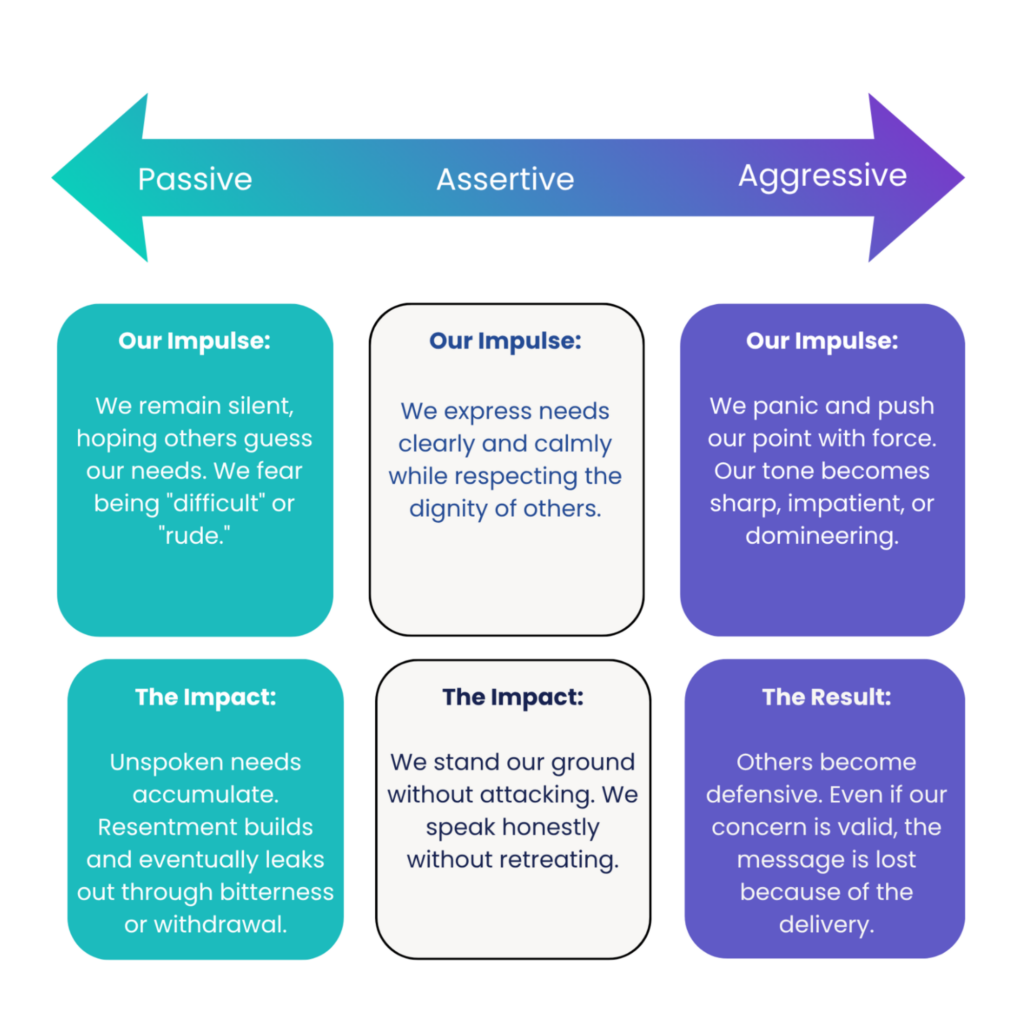
In these moments, we feel the tension between what we need to say and what we are actually able to express. Far too often, we respond in one of two equally harmful ways: Passivity (swallowing our need) or Aggression (forcing our point).
By understanding what asserting ourselves means and how it sits at the midpoint between these two unhelpful extremes, we can better evaluate how assertiveness deals with conflict.
The inner game of assertiveness
Although assertiveness is often described as a communication skill, something we can learn through a set of phrases, learning how to build assertiveness is a much bigger inner game. It reflects our emotional confidence and the degree to which we believe our presence in the room is legitimate.
The trap of compliance
We often mistake being easy-going for being kind. But there is a hollow kind of niceness that is actually a form of self-abandonment. When we prioritize the comfort of the room over the truth of our experience, we aren’t being kind, we’re being dishonest. Real intimacy requires friction. True kindness is the willingness to be uncomfortable for the sake of being seen and understood.
The feeling of insignificance
If we grew up in environments where our adults consistently undermined the value we brought as children, equating worthiness with age, we ran the risk of feeling insignificant. We would have interpreted our interactions with elders as inconvenient or burdensome to them, and learned that expressing ourselves is a nuisance. To understand how to be more assertive, we must nurture a quiet conviction that we are allowed to have opinions, preferences and unpopular viewpoints, and that they do matter.
Emotional architecture
Think of assertiveness as a bridge between your private world and the public one. Our private, raw emotions need to be structured in a manner so that others can digest and work with them. Learning how to build assertiveness is this structure, or architecture that takes the heavy weight of your feelings and holds your message without collapsing the relationship. This is the essential benefit of assertive communication.
A toolkit for assertive living
The habit of assertiveness becomes natural rather than forced when we develop 4 pillars of awareness:
The right to exist
You do not need permission to have boundaries. Assertiveness begins with the shift from “Am I being a bother?” to “My perspective is a legitimate part of this conversation.”
Emotional awareness
Before you can communicate, you must recognize what you feel. This is how to practice mindfulness in daily life, transforming a reactive impulse into a conscious response. Emotional awareness, as a mindful practice, allows you to pause and ask:
What’s going on right now? What’s this discomfort making me aware of? What needs are not being met and which values are not being upheld right now? What do I need in this situation?
Structured and clear expression
Avoid blame and hidden messages. By learning to use the right language, we avoid generalisation, exaggeration and judgement.
- Instead of: “You never listen to me.”
- Try: “When I’m interrupted, I feel dismissed. I’d appreciate being able to finish my point.”
The courage to tolerate discomfort
Many people avoid assertiveness because they fear awkward silence or the other person’s reaction. Assertive living requires us to develop a strong sense of Self in society, building the muscle to stand steady when things feel tense. Discomfort is not a sign that something is wrong, often, it’s simply the feeling of honesty entering a relationship.